

In Depth with Peter Ayers
Emma Navarro's longtime coach on their journey

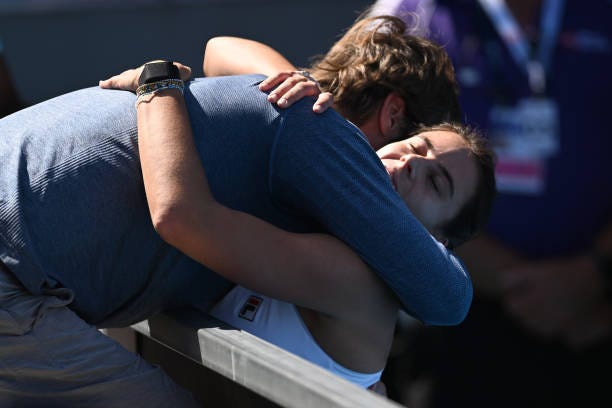
NEW YORK – Peter Ayers, Emma Navarro’s longtime tennis coach, started out with a love of team sports, and in a sense, that has never changed. When we met for our discussion this week in the player garden at the US Open, he arrived in a blue Los Angeles Dodgers cap.
His memories of playing on the tennis team at Duke University, where he was an All-American, are among the happiest of his life, and though Ayers’ mentee and employer Navarro is now a genuine women’s singles star, he and Navarro have approached tennis as a team endeavor for nearly a decade.
It is a rare achievement to guide a player from the early junior stage to the top 10 of the professional game, but Ayers’s passion for teaching comes through in his tone and his earnest words.
“We’ve done a lot of great work together,” Navarro, 23, said to Ayers on court in New York. “Thank you for everything you do, your dedication, all the time you put into the journey and making me into the player I am.”
Navarro, the daughter of Kelly Navarro and billionaire businessman Ben Navarro, was far from Ayers’ first pupil. Ayers taught scores of players, both juniors and adults, before moving from his longtime base of Charlotte, North Carolina to Navarro’s home city of Charleston, South Carolina.
He first coached Navarro’s younger sister Meggie, who later followed Emma to the University of Virginia. But Ayers and Emma have worked together for nearly a decade, and Ayers continued to coach her on a regular basis during her two years at Virginia.
In just two years, they have come a remarkably long way, as this breakthrough season and the semifinal run at the 2024 US Open make clear. But neither Navarro nor Ayers is focused on the results as much as on the process.
My conversation with Ayers has been condensed and lightly edited for clarity.
On how they have built her career:
We’ve been together for a long time. When I started with her, she was already on a good track and had a wonderful foundation, but it was just about, ‘Okay, let's see how good you can be as a player, and let's see what we need to do to get you on track to becoming that.’ I don't know that professional tennis was necessarily in her wildest dreams at that point. It was more just wanting to see how good you can get. I think that quest appealed to her, and so that's where we started, and that's where we still are. The byproduct is that we found ourselves here, because we've never strayed from that ultimate ideal: What are you doing today that's going to help you just inch a little bit more toward that ultimate goal of becoming the best version of yourself?
On how often they repeat that catchphrase:
A lot. I think it's important to just keep you grounded, because when you get involved in tournaments, the small picture is so in your face. And it's important. I mean she desperately wants to win tennis matches. I want her to win tennis matches. It's fun to make deep runs in tournaments. We get all that. It's part of it, but we don't want that to take over, and so we just balance it out with saying, ‘Look, that small picture is there, but let's never lose track of the big picture, because a couple days after the tournament, that's what's going to need to be in charge again.’ So we are constantly reiterating these values and themes that, I should make clear, are hers. Maybe I helped her formulate them, but these are things that she believes in, so I think you can't be reminded of it too much.
On their initial meeting at the LTP Academy in Charleston:
It was at least 11 years ago. I was not her primary instructor, but there were times where her primary instructor needed someone to step in. I had just moved to Charleston with my family. We knew this is where we wanted to raise our kids, and I dropped my resumé at every club, and LTP was the one that said we found a place for you here. I just started from scratch in my career again and not long after being there I got a chance to be on court with her. It was kind of surreal.
She was really quiet but just the combination of eyes and hands was for sure something special. No doubt about it. I remember tossing balls for her and just working on the detail of a forehand open stance. I can remember the cues I was giving her. I had coached a lot and been around a lot of good players and had moved kids through the junior ranks into college. But I had never been around someone who's just purely striking the ball over and over again. And as good as she was, there was never a, ‘Well, how many more of these are we going to do?’ It was just another ball, another ball, At that age, the patience, and I think maybe even the pleasure that she derived from just striking the ball was part of that. I actually started working primarily with her younger sister first, and we were at least year and a half or so into our relationship, and then the opportunity to take on a primary role with Emma came about. It was for the Easter Bowl (in 2016). She was 14, getting ready to turn 15. So, we’re now in our 9th year.
On what he worked on in Emma’s game when they began working full-time together:
There was a lot of stuff in place of course. The thing that I’ve tried to do is you may see ten things but the question is what's most relevant right now? What's the domino we need to knock down right now? Because if we don't knock this one down, the rest is not gonna matter. So it’s having the patience and the persistence when maybe everybody's saying, ‘What about this? Or what about this?’
On the first domino: