

Back on his Feet
Sinner Returns to the Fore at Wimbledon but Something is Missing

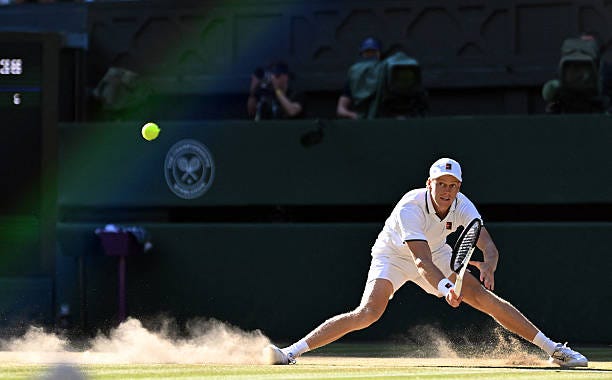
WIMBLEDON – Order was partially restored on Sunday at the granddaddy of all tennis tournaments.
Jannik Sinner, the No. 1 who was often unplayable this spring on smaller stages, is a Grand Slam champion again after a surprising year-long drought. He defended his title on a blustery day at Wimbledon against an inspired and emboldened Alexander Zverev, lying in wait for his rare opportunities and pouncing in his unique predatorial fashion: gangly but deadly.
Sinner’s 6-7 (7), 7-6 (2), 6-3, 6-4 victory was a 21st century version of Wimbledon finals past between the likes of Pete Sampras and Goran Ivanisevic, when the big serve ruled and break points were nearly as rare as black socks at the All England Club.
But this is of course a very different era with serve-and-volley a niche play if it is deployed at all, and with champions like Sinner and Zverev more accustomed to making mayhem from the baseline. Though there was a surplus of unreturned serves on this windy Sunday, there were also just enough flashy exchanges, just enough shifts of pace and direction, to make this a spectacle worth nearly four hours of our time in a distracted world.
Not that I’m signing up for this every July. The game sorely misses the injured Carlos Alcaraz: his creative streak and his big-match charisma. I will stick by my line above about order being partially restored.
But as a change of pace, this final passed the test, even if Sinner-Zverev, unlike Sinner-Alcaraz, is no rivalry.
The outcome on Sunday was business as usual. Sinner has now beaten Zverev 10 times in a row, twice in major finals. But the content at least was fresh as Zverev committed himself from the opening game to being more aggressive with his forehand, taking huge cuts into the corners to try to keep Sinner from taking first-strike command.
The second point felt like a declaration of intent as Sinner pounded a first serve and moved forward to control the space and geometry only to get pushed back quickly by back-to-back Zverev forehand bolts crosscourt. Zverev kept letting it rip and then downshifted: winning the 22-shot rally with a drop shot-volley combination.
It would have been a version of insanity to change nothing after losing nine times and 14 sets in a row. Zverev is clearly sane and if we’re being fair, he has tried the forehand beast mode against Sinner before without sustaining it.
But here’s the bad news: Sinner went on to hold in that opening game on Sunday. And now for the really bad news: Sinner went on to hold in every game he served on Sunday.
Zverev did win his first set of the season against the Italian, playing a brilliant tiebreaker in which he managed to find just the right blend of power and control, making no unforced errors in 16 points and finishing with a chef’s kiss of a forehand winner down the line.
The exultant Zverev, like the rest of us, saw the symbolism in that, but it was ultimately a tease.
Zverev’s performance and forehand in the second-set tiebreaker were not nearly as spotless. By final’s end, he had hit 15 forehand winners and 28 forehand unforced errors. And despite being 6-foot-6 and possessing the wingspan of a World Cup goalkeeper, Zverev would get only one break point against Sinner all day.
That did not come until midway through the third set with Sinner serving at 3-all, ad-out. Sinner had to hit a second serve, and the rally began. Though audacity was surely in order, Zverev chose to slice his backhand, with ample time and space available, on his second stroke of the exchange. It landed short, too short. Sinner went down the line with a cocksure backhand, putting Zverev on the defensive. The German poked a sliding forehand back into play. Sinner moved forward to attack the short ball, and with Zverev so far behind the baseline that he was actually standing on Centre Court lawn instead of Centre Court dirt, Sinner smartly hit a drop shot.
The poorly positioned Zverev pushed off, slipped on the grass and fell to earth, clutching his right knee. There were gasps from the gallery and understandable concern. Sinner crossed over to gallantly help Zverev to his feet, and the match continued. But it would not be quite the same match again.
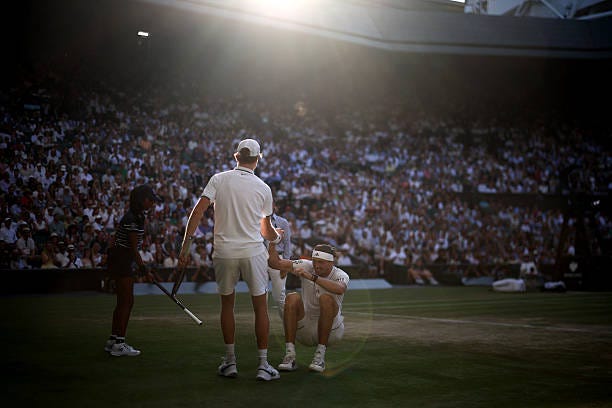
Zverev said he “overextended” his knee.
“I was struggling to push off on the serve a little bit, so my serve speed went down,” he said. “But everything else went fine. I was moving fine from the baseline and playing from the baseline fine. But on the serve, I was struggling a little bit more.”
In the next game, he went up 40-15, only to miss a backhand approach shot and a routine backhand crosscourt. He double-faulted into the net on his next game point and mishit a forehand just long at deuce to give Sinner a break point, which was only his second of the match.
Sinner settled into his return stance, blowing on the fingers of his right hand. Zverev missed the first serve, put the second into play and then hit a crosscourt backhand sharply enough that Sinner, scrambling to his left, slipped to the grass as he put the ball back in play.
Here’s how that looked:
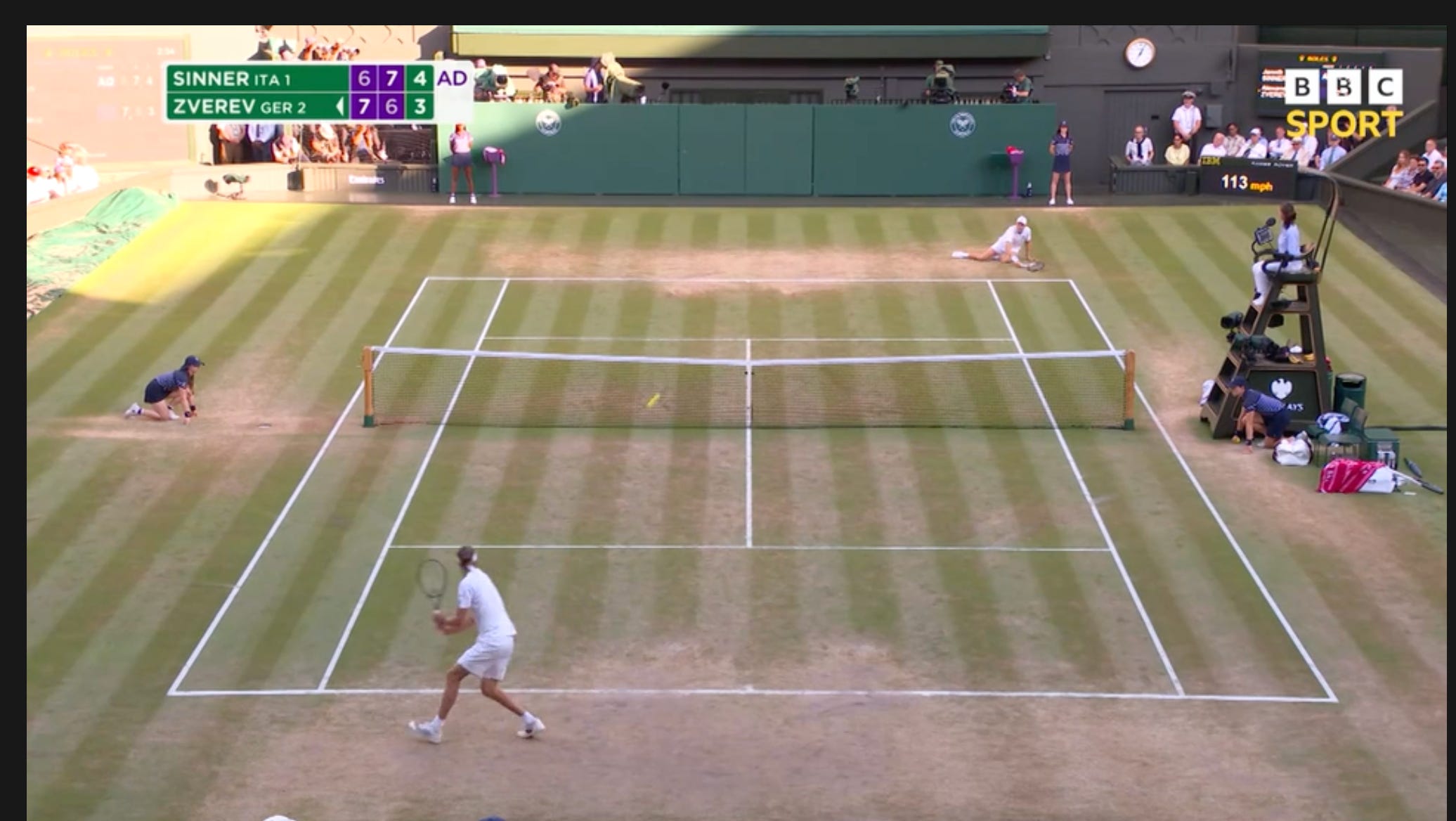
Zverev now had a great deal of open court to work with and hit a backhand toward the void but without quite enough conviction or velocity. Sinner, who had leaped to his feet in a blink, tracked down the ball and rebooted the rally, which he won when Zverev mishit another forehand long.
After two hours and 54 minutes, Sinner had the first break of this pitcher’s duel. Zverev, frustrated and perhaps seeing the handwriting through the ivy on the wall, sent his racket skidding across the turf.
Rafa Nadal would not have approved, although Rafa Nadal never lost 10 straight matches against anyone (not even Novak Djokovic).
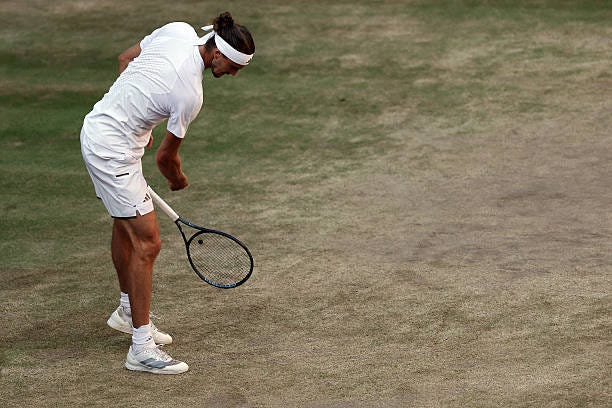
Just like that, Sinner held at love, finishing with an ace to take a two sets-to-one lead. He was soon closing in on his fifth major title in the golden early-evening light that transforms Wimbledon into a landscape painting (unless they close the roof too early and switch on the lights).
Sinner played a brilliant game to break Zverev at 3-3 in the final set: continuing to get a better read and bead on Zverev’s mammoth serves and sliding around the grass as if he were still in Rome or at Roland Garros.
Sinner played another brilliant game at 5-4 as he served for the championship. At 30-all, Zverev went all in, pounding strokes into the Italian’s backhand corner as Sinner skidded, stretched and counterpunched and then sprinted forward to chase a very good drop shot, which he answered with a beautifully weighted backhand crosscourt on the slide that the lunging Zverev could not quite handle.
Zverev looked at his box the way Roger Federer’s opponents used to look at their boxes at Wimbledon. Sinner grinned, gasped for breath and then coolly hit a forehand winner down the line to retain possession of the trophy.
He dropped to his back, put his hands over his face, and looked both overjoyed and relieved. Such a mix of emotions might have seemed surprising to those in Britain and beyond who tune into Wimbledon and only Wimbledon, where Sinner is self-evidently a Winner.
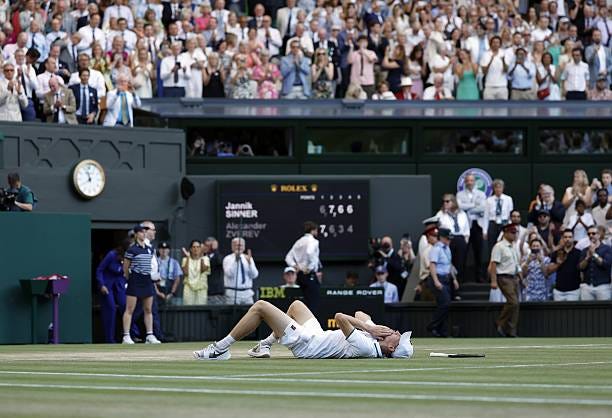
But Sinner, for all his dominance from March to May, has had a tough stretch in the other majors. He lost the US Open final last September to Alcaraz, lost to Djokovic in the Australian Open semifinals in January and then abruptly lost the plot in the Paris heat in the second round of the French Open with a two-set, 5-2 lead on the unheralded Juan Manuel Cerundolo.
It was one of the most stunning collapses in any sport’s history and raised another round of questions about Sinner’s staying power.
“It’s not something we can put our finger on and know exactly what happened,” said Darren Cahill, one of Sinner’s coaches. “He went away and did what he needed to do with the testing and made a few changes to his preparation, the way he prepares for the hot days. But we don’t really know it was that in Paris. It was just one of those things we don’t really have answers for. It goes to show the maturity of the player that we’re working with in Jannik, that he can take a kick in the guts like that, come back here, work his ass off.”
Sinner and his team chose to skip the grasscourt tuneup tournament in Halle. Instead, he arrived nearly two weeks early in London to train.
“We knew the first couple matches were going to be really difficult for him to get through,” Cahill said.
That proved true. Sinner was pushed to five sets in the first round by Miomir Kecmanovic, missing forehands that he usually makes with his eyes closed.
Anyone who watched that erratic, edgy display could not take Sinner’s focused excellence against Djokovic in the semifinals or against Zverev on Sunday for granted. Sinner had more than twice as many winners in the final as unforced errors (58 to 25). He won 80 percent of his first-serve points and 65 percent of his second-serve points. Above all, he defused a newly dangerous opponent, blocking back 137 mile-per-hour serves and coming up with the shots he needed most when it mattered most.
That is a champion’s formula, and the Wimbledon men’s event has certainly been fertile ground for serial achievement. Federer won a record eight singles titles. Sampras and Djokovic have won seven. Bjorn Borg won five in a row. Alcaraz won back-to-back titles in 2023 and 2024 before losing to Sinner in last year’s final.
At this stage, given Sinner’s footwork and racket-work, it is no stretch to imagine him with several more titles at the All England Club, several more opportunities to hold up the trophy and take in the balcony view of the grounds and the cosmopolitan faithful capturing his moment (and theirs) with phones and appreciation extended, 21st-century style.
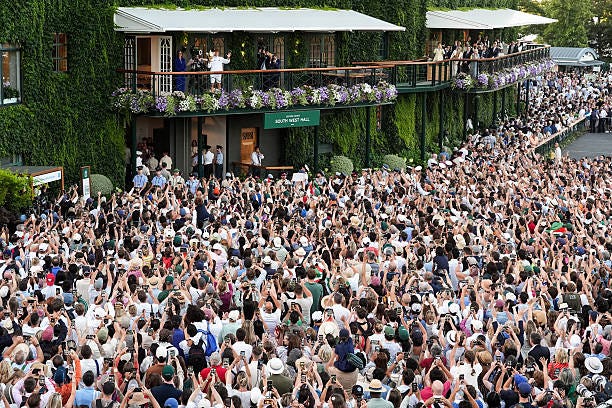
This grassy, codified place has changed to be sure but retained its essence. That not only suits his game. It suits his understated style. Wimbledon is, as it turns out, the only Grand Slam tournament he watched regularly as a youngster growing up in Alpine splendor in the Italian Dolomites.
“Back in the days until when I was 14, 15 years old, I was not a lot into tennis because I was skiing,” Sinner, a former elite junior ski racer, told the BBC. “I was spending a lot of time with my friends playing football, and tennis was basically the third sport. But when Wimbledon was on, I was always watching on TV.”
Zverev, in nearby Germany, watched all the majors except Wimbledon.
“Unfortunately, in Germany, Wimbledon was always on a private, paid TV channel, and all the other Slams were always on Eurosport,” he told the BBC. “So. I never got to watch Wimbledon. I never got to experience what Wimbledon felt like. The first memory of it was the Roger-Rafa final back in 2008, but it was not from watching it live.”
Instead, he watched highlights of Nadal’s magnificent five-set breakthrough, which came in the gloaming and after he had lost to Federer in two straight finals.
That redemption story should give Zverev some hope. He had never been past the fourth round here until this year and at 29, after winning his first major at Roland Garros, he seems ready to break down some other barriers. With his huge serve and his success elsewhere on grass, he was a Wimbledon underachiever until now.
“At 29 years old, this year was the first time I actually believed I could win this,” he said in his post-match remarks to the crowd in Centre Court.
But Sinner and Alcaraz already have won Wimbledon twice apiece and with Sinner just 24 and Alcaraz still 23, the odds and the timeline are against Zverev.
Plenty of fans still are, too, given the allegations of domestic abuse that were made against him in Germany by a former partner. He denied those allegations and in June 2024, the case was settled and criminal proceedings against Zverev were discontinued. The discontinuation was not a declaration of guilt or innocence and left Zverev with no criminal record.
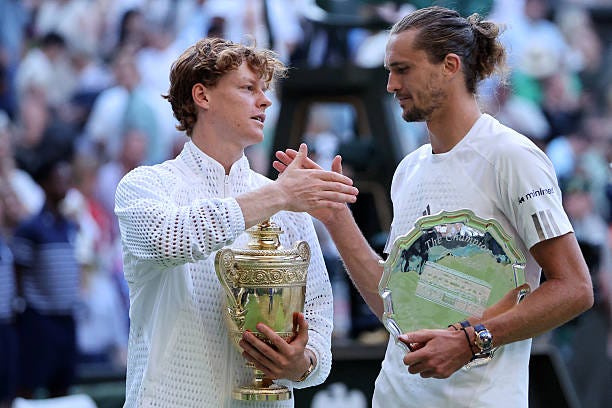
He was received warmly at Wimbledon on Sunday, and he and Sinner exchanged pleasantries as easily as they exchanged backhands and forehands.
“Big, big respect for Sascha, because he’s doing something amazing; his game is growing and growing,” Sinner said. “That’s exactly what’s good, because you have always someone who is pushing you to the limit. We hope that Carlos is coming back, as well, because tennis needs him.”
For now, with Alcaraz’s wrist still a major concern, Sinner is No. 1 in the rankings and Zverev is back at No. 2. And though it was quite a sight to see the finalists pound serves on the lines on Sunday amid the swirling wind and mounting pressure, men’s tennis is not yet back to full strength.
CC
P.S. I have a bit more Wimbledon coverage to come. Thanks to all of you for being here. A special thanks to all of those who support my work by buying my books or becoming paying subscribers to Tennis & Beyond. It’s a pleasure to exchange ideas with you.
Terrific writing. I especially appreciate your attention to a couple of turning points in the match, which has become a lost art in most media coverage of big matches.
Trivia question: Carlos Alcaraz does something regularly that no other player on tour does - What is it? Hoping he can overcome his wrist problem!!
Sean Sloane